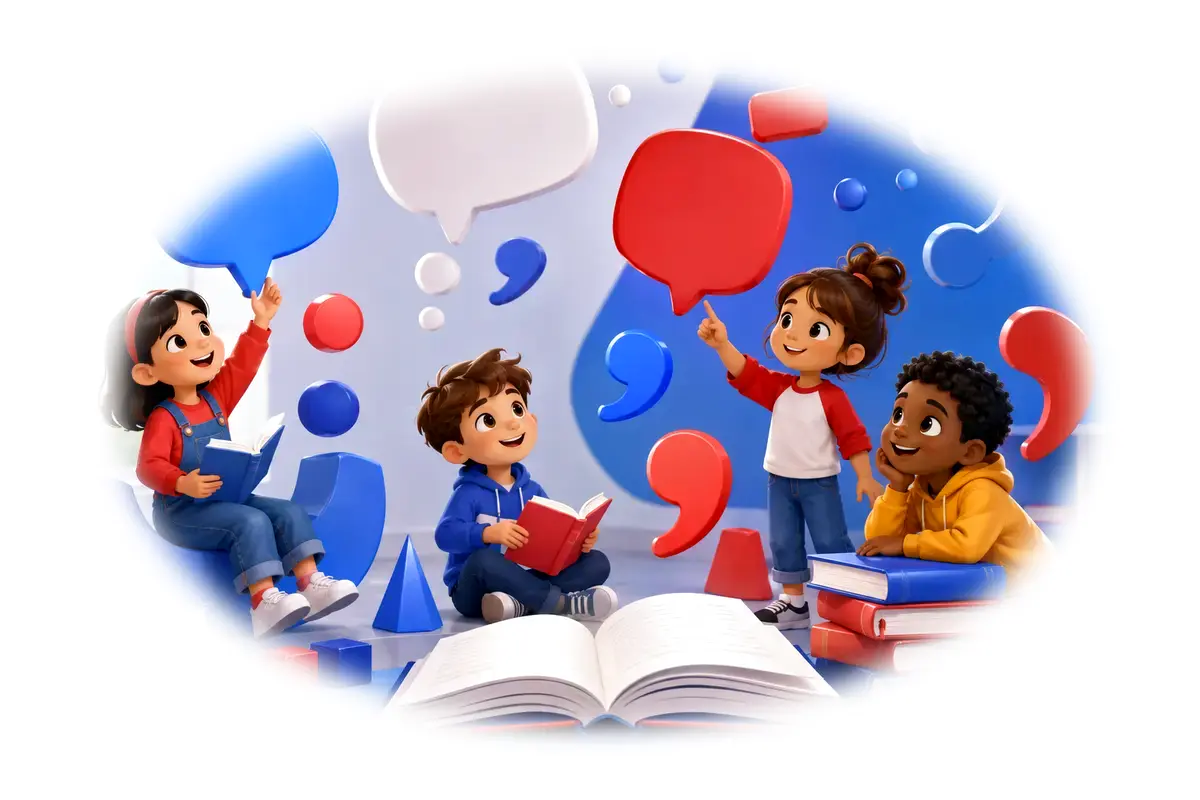
Le contenu reste le même, mais le score et l’animation s’adaptent au groupe. Choisissez le mode qui correspond au nombre de participants : solo pour une partie rapide, famille pour réfléchir ensemble, équipes pour créer un défi ou animateur pour piloter la partie devant un groupe.
Question 1 sur 20Score : 0
Question 1Niveau 2/3
Which sentence correctly illustrates “first conditional”?
Bonne réponse : If it rains, we will stay inside.
“If it rains, we will stay inside.” correctly illustrates the grammar point “first conditional”.
Réponse : If it rains, we will stay inside. — “If it rains, we will stay inside.” correctly illustrates the grammar point “first conditional”.
Question 2Niveau 2/3
Complete: “The bank is … the bakery and the school.”
Bonne réponse : between
Between locates something in the space separating two elements.
Réponse : between — Between locates something in the space separating two elements.
Question 3Niveau 2/3
Which sentence correctly illustrates “modal should”?
Bonne réponse : You should rest.
“You should rest.” correctly illustrates the grammar point “modal should”.
Réponse : You should rest. — “You should rest.” correctly illustrates the grammar point “modal should”.
Question 4Niveau 3/3
Which sentence correctly illustrates “modal may”?
Bonne réponse : It may rain.
“It may rain.” correctly illustrates the grammar point “modal may”.
Réponse : It may rain. — “It may rain.” correctly illustrates the grammar point “modal may”.
Question 5Niveau 2/3
Which sentence correctly illustrates “ever in a question”?
Bonne réponse : Have you ever visited London?
“Have you ever visited London?” correctly illustrates the grammar point “ever in a question”.
Réponse : Have you ever visited London? — “Have you ever visited London?” correctly illustrates the grammar point “ever in a question”.
Question 6Niveau 3/3
Complete: “This result is … than yesterday’s.”
Bonne réponse : better
Better is the irregular comparative of good.
Réponse : better — Better is the irregular comparative of good.
Question 7Niveau 1/3
Which sentence correctly illustrates “comparison as as”?
Bonne réponse : Mia is as tall as Zoé.
“Mia is as tall as Zoé.” correctly illustrates the grammar point “comparison as as”.
Réponse : Mia is as tall as Zoé. — “Mia is as tall as Zoé.” correctly illustrates the grammar point “comparison as as”.
Question 8Niveau 1/3
Complete: “How … books are on the shelf?”
Bonne réponse : many
Many is used with the countable plural noun books.
Réponse : many — Many is used with the countable plural noun books.
Question 9Niveau 1/3
Which sentence correctly illustrates “do not have to”?
Bonne réponse : You do not have to come.
“You do not have to come.” correctly illustrates the grammar point “do not have to”.
Réponse : You do not have to come. — “You do not have to come.” correctly illustrates the grammar point “do not have to”.
Question 10Niveau 2/3
Which sentence correctly illustrates “never with present perfect”?
Bonne réponse : I have never flown.
“I have never flown.” correctly illustrates the grammar point “never with present perfect”.
Réponse : I have never flown. — “I have never flown.” correctly illustrates the grammar point “never with present perfect”.
Question 11Niveau 2/3
Which sentence correctly illustrates “negative past did not”?
Bonne réponse : They did not come.
“They did not come.” correctly illustrates the grammar point “negative past did not”.
Réponse : They did not come. — “They did not come.” correctly illustrates the grammar point “negative past did not”.
Question 12Niveau 3/3
Complete: “We … this film already.”
Bonne réponse : have seen
Have seen is the present perfect form used with we and already.
Réponse : have seen — Have seen is the present perfect form used with we and already.
Question 13Niveau 1/3
Which sentence correctly illustrates “future will”?
Bonne réponse : I will help.
“I will help.” correctly illustrates the grammar point “future will”.
Réponse : I will help. — “I will help.” correctly illustrates the grammar point “future will”.
Question 14Niveau 2/3
Which sentence correctly illustrates “future question”?
Bonne réponse : Will you come?
“Will you come?” correctly illustrates the grammar point “future question”.
Réponse : Will you come? — “Will you come?” correctly illustrates the grammar point “future question”.
Question 15Niveau 2/3
Complete: “She … a blue bicycle.”
Bonne réponse : has
In the simple present, have becomes has with she.
Réponse : has — In the simple present, have becomes has with she.
Question 16Niveau 2/3
Complete the future sentence: “They … tomorrow.”
Bonne réponse : will play
Will followed by the base verb expresses the future here.
Réponse : will play — Will followed by the base verb expresses the future here.
Question 17Niveau 1/3
Which sentence correctly illustrates “present perfect I”?
Bonne réponse : I have finished.
“I have finished.” correctly illustrates the grammar point “present perfect I”.
Réponse : I have finished. — “I have finished.” correctly illustrates the grammar point “present perfect I”.
Question 18Niveau 2/3
Which sentence correctly illustrates “past question did”?
Bonne réponse : Did you call?
“Did you call?” correctly illustrates the grammar point “past question did”.
Réponse : Did you call? — “Did you call?” correctly illustrates the grammar point “past question did”.
Question 19Niveau 1/3
Which sentence correctly illustrates “comparison than”?
Bonne réponse : A train is faster than a bike.
“A train is faster than a bike.” correctly illustrates the grammar point “comparison than”.
Réponse : A train is faster than a bike. — “A train is faster than a bike.” correctly illustrates the grammar point “comparison than”.
Question 20Niveau 3/3
Which sentence correctly illustrates “relative pronoun where”?
Bonne réponse : This is the park where we play.
“This is the park where we play.” correctly illustrates the grammar point “relative pronoun where”.
Réponse : This is the park where we play. — “This is the park where we play.” correctly illustrates the grammar point “relative pronoun where”.
🏆
Quiz terminé
Votre résultat
Les explications restent accessibles en rejouant ou dans la version imprimable.
Le même questionnaire peut se jouer seul, à plusieurs ou devant un groupe. Choisissez le mode selon le nombre de participants et la place que vous voulez laisser à la discussion.
Le niveau 12-14 ans privilégie des formulations plus nuancées, des réponses proches et des défis de raisonnement.
🎯
Solo
Réponse immédiate, score automatique et explication après chaque question.
👨👩👧
Famille
Discutez avant de répondre et transformez le quiz en moment collectif.
🏆
Équipes
Le tour passe d’une équipe à l’autre et le tableau de scores se met à jour.
🎤
Animateur
Projetez les questions et attribuez manuellement les points aux équipes qui répondent.